We supply crude whole scorpion venom. One species, Leiurus quinquestriatus from the Aswan region of Egypt, we hold in stock and price daily on the venom exchange. The others are quoted on request against a named batch, with the same documentation: a product specification, a safety data sheet and a certificate of analysis for the batch delivered.
Species
- Leiurus quinquestriatus, yellow Mediterranean scorpion. In stock, priced daily on the exchange.
- Androctonus crassicauda, Arabian fat-tailed scorpion
- Androctonus australis, yellow fat-tailed scorpion
- Androctonus turkiyensis
- Androctonus turkestani
- Androctonus kunti
- Hottentotta saulcyi
- Hottentotta schach
- Hottentotta jayakari
- Hottentotta zagrosensis
- Hottentotta juliae
- Odontobuthus doriae
- Hemiscorpius lepturus
- Mesobuthus eupeus, lesser Asian scorpion
- Heterometrus spp., Asian forest scorpions
Email us with the species, the quantity, the destination country and the intended use, and we quote the batch, the form, the lead time and the price. Dried crude whole venom is the standard form. A species that isn’t on the list is worth asking about too.
The rest of this page is about the species we stock: origin, composition, specification and what arrives.
Leiurus quinquestriatus
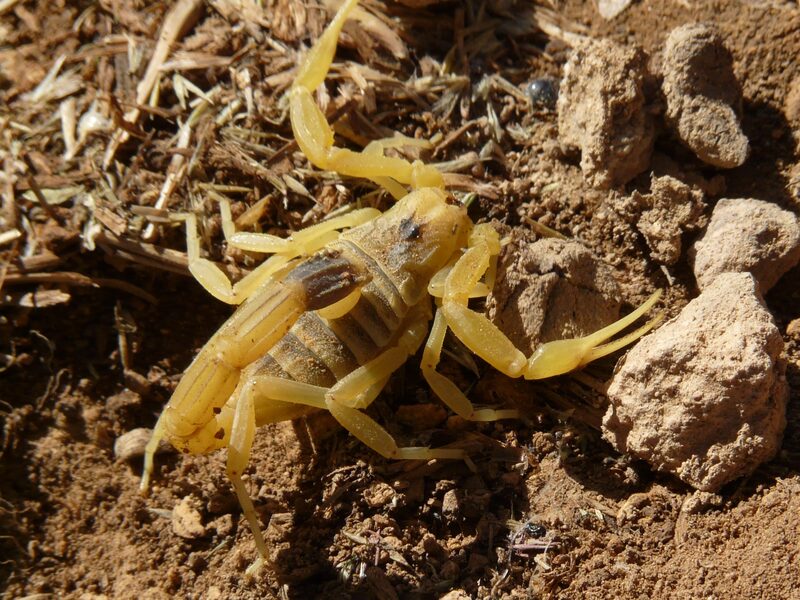
Leiurus quinquestriatus is a buthid scorpion of the arid belt running from North Africa across the Middle East, and it goes by several names in the literature: the deathstalker, the yellow Israeli scorpion, and the yellow Mediterranean scorpion. Egypt sits inside its natural range, and the animals we work with are sourced from farms in the Aswan region rather than from colonies bred elsewhere.
The north-African population is distinguishable from the Levantine form; Sigma-Aldrich catalogues the two separately on a stated electrophoretic difference. Ours is the north-African one.
Composition
Crude whole venom is the complete secretion, unfractionated and without additives, carriers or preservatives: neurotoxic peptides, enzymes such as hyaluronidase and phospholipase, mucopolysaccharides, free amino acids and salts. The named toxins of L. quinquestriatus:
| Toxin | Target | Typically used for |
|---|---|---|
| Chlorotoxin | Small-conductance chloride channels; binds glioma cells and MMP-2 | Tumour targeting and imaging, glioma research |
| Charybdotoxin | Calcium-activated potassium channels (BK), Kv1 subtypes | Potassium channel pharmacology |
| Agitoxins 1–3 | Shaker-type Kv1 channels | Channel structure and gating studies |
| Scyllatoxin (leiurotoxin I) | Small-conductance calcium-activated potassium channels (SK) | SK channel characterisation |
| Alpha and beta sodium-channel toxins | Voltage-gated sodium channels, some insect-selective | Sodium channel research, bioinsecticide work |
Intended use
Supplied as a laboratory chemical against the specification below, for laboratory and manufacturing use. We make no GMP or pharmacopoeial claim; qualifying it for a regulated process is the buyer’s to do. This is not a medicinal product and is not for administration to humans or animals.
Extraction
Venom is milked from scorpions held at farms in the Aswan region, without harming the animals; the same animal is milked repeatedly over its life, with a recovery period between extractions. An adult yields a few milligrams of dry venom per extraction, and yield falls in the cold months, so supply is seasonal. The collected venom is pooled and pulverised into powder at a laboratory, then sealed.
What arrives
Crude venom powder, white to yellow, in a sealed vial. The standard fill is 100 mg, product code HLX-VEN-LQ-100; quantities of a gram and above are HLX-VEN-LQ-BLK, supplied on request. The minimum order is 100 mg.
The specification
Every batch is released against the acceptance criteria below. They are the published specification, HLX-PS-0001; the certificate of analysis that accompanies a delivery reports that batch’s results against them.
| Attribute | Acceptance criterion | Method |
|---|---|---|
| Appearance | White to yellow powder | Visual |
| Solubility | Soluble | Visual |
| Identity | Electrophoretic pattern consistent with the reference venom | SDS-PAGE, reducing, 10 % gel |
| Protein concentration | Up to 2 mg/mL | Stoscheck 1990 / Layne 1957 |
| Venom potency (LD50) | 7 ± 1.4 µg/mouse | Zlotkin et al. 1976; Hossan 1984 |
| pH | Reported on the batch certificate | pH meter |
Identity is established by SDS-PAGE under reducing conditions on a 10 % gel, run against a 6–97 kDa low-molecular-weight standard and against a reference venom. Bands span roughly 6–80 kDa, with the densest material at the low-molecular-weight end.
Potency is determined in mouse on each batch, not taken from the literature, and the result is on that batch’s certificate.
Storage and handling
Shipment is arranged to hold the storage condition in transit; tell us if your incoming-goods procedure needs cold-chain documentation and we will provide it. On arrival, store at 0 to 4 °C, protected from light, in a dry, well-ventilated place with the container tightly closed. Reconstitute in buffer immediately before use and avoid repeated freeze-thaw cycles, which cost you activity.
Handling, exposure controls and personal protective equipment are in the safety data sheet below.
Documents
-
Product specification, crude whole venom (HLX-PS-0001)
Identity, acceptance criteria and methods, storage, regulatory status and fill sizes.
-
Safety data sheet (HLX-SDS-0001)
Hazards, first aid, handling and storage, exposure controls, transport and disposal.
Both are issued under our quality management system and prepared by Dr. med. univ. Dagmar Zidek, of our board. Each delivery is accompanied by the certificate of analysis for that batch; any further documentation is agreed before the order.
Compliance
The venom is not classified as hazardous under Regulation (EC) No 1272/2008, and it is not classified as dangerous goods under ADR, RID, IMDG or IATA. Neither Leiurus quinquestriatus nor any other species on the list above is in the CITES appendices.
Export from Egypt and import into your territory remain subject to the customs and biological-material controls that apply to material of animal origin, and those differ by destination. We coordinate export logistics from Egypt. You are the importer of record and hold whatever authorisation applies at destination; tell us the destination country and the intended use when you enquire, and we will tell you what has been accepted on previous shipments to that market.
Price and ordering
The price per gram is published and updated daily on our venom exchange, the first exchange in the world for this material, along with the volume pricing. Orders are priced at the moment you send them. The other species are quoted on request.